
What Should My Pool's pH Level Be?
Short answer
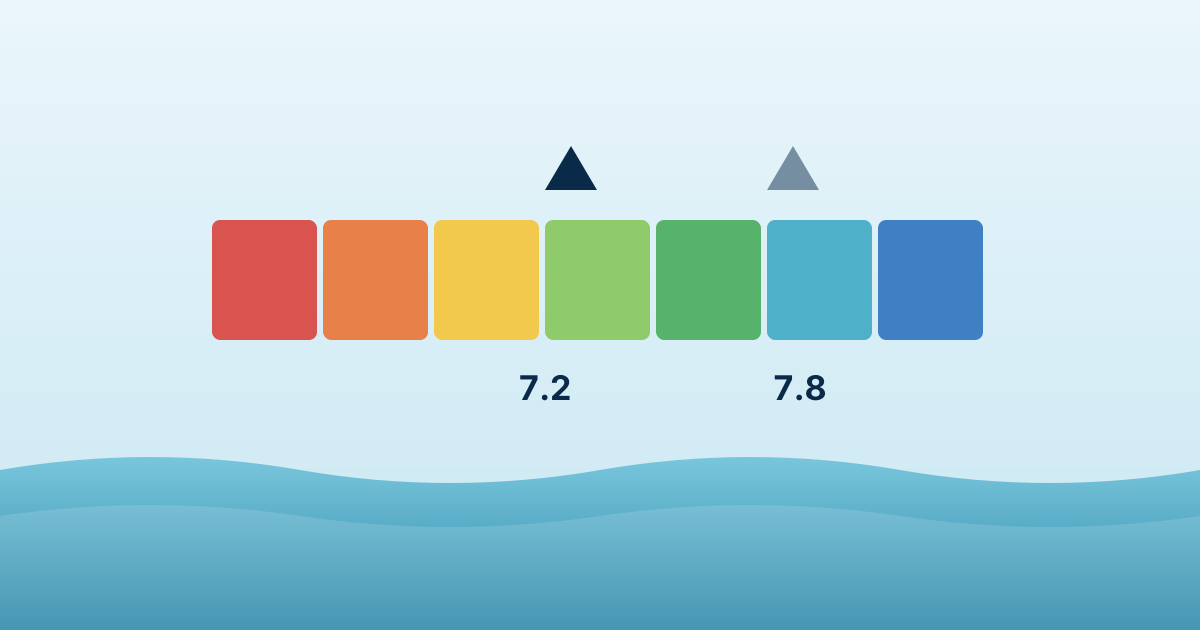
Pool pH should be kept between 7.2 and 7.8, with 7.4 to 7.6 as the ideal target. Below 7.2 the water becomes corrosive to plaster, grout and metal parts. Above 7.8 chlorine loses much of its killing power and scale and cloudiness begin to form.
Your pool’s pH should sit between 7.2 and 7.8, and the sweet spot is 7.4 to 7.6. That narrow band is where chlorine works efficiently, where the water feels comfortable on skin and eyes, and where your plaster, tile grout, liner and metal components are not being slowly eaten or coated.
pH is the single most important number in pool water because almost everything else depends on it. Get pH wrong and good chlorine readings still will not sanitize properly.
Why 7.4 to 7.6 specifically
Chlorine in water exists in two forms, hypochlorous acid (the strong sanitizer) and hypochlorite ion (much weaker). pH decides the split.
- At pH 7.0, roughly 73 percent of your free chlorine is the strong form
- At pH 7.5, roughly 50 percent
- At pH 8.0, only about 21 percent
So a pool reading 3 ppm chlorine at pH 8.2 is sanitizing far worse than a pool reading 2 ppm at pH 7.5. Human tear fluid also sits close to 7.4, which is why properly balanced water does not sting.
What goes wrong outside the range
Low pH (below 7.2) makes water aggressive. It etches plaster, dissolves grout, corrodes ladders, heater exchangers and pump seals, and fades vinyl liners. Damage from acidic water is permanent and expensive.
High pH (above 7.8) is the more common drift. It causes:
- Weak, sluggish sanitizing even with adequate chlorine
- Cloudy water that will not clear
- Calcium scale on tile, waterline and heater elements
- Filter media clogging faster
How to test and correct it
Test pH at least twice a week with a good drop-based test kit or a digital tester. Test strips are acceptable for a quick check but drift with heat and humidity, so replace them often and never leave the bottle open.
To lower pH, use muriatic acid or dry acid (sodium bisulfate). A rough starting point is about 12 fluid ounces of 31.45 percent muriatic acid per 10,000 gallons to drop pH roughly 0.2, but the exact amount depends heavily on your total alkalinity. Add it slowly to a deep area with the pump running, then retest after several hours of circulation.
To raise pH, use soda ash (sodium carbonate), roughly 6 ounces per 10,000 gallons to raise pH about 0.2. Borax works too and is gentler on alkalinity.
Always check total alkalinity first. Alkalinity between 80 and 120 ppm is what keeps pH from bouncing. If alkalinity is low, pH will swing wildly no matter how much acid or soda ash you add. Fix alkalinity, then fine tune pH.
What pH drift is telling you
Constantly rising pH usually points to one of these:
- A saltwater chlorine generator (they naturally push pH up)
- Aeration from waterfalls, spa jets, fountains or heavy splashing
- Fresh plaster curing, which pushes pH up for the first several months
- Total alkalinity above 120 ppm
Constantly falling pH often means heavy trichlor tablet use, acidic rain, or over-correcting with acid.
The Key West factor
Fill water here comes down the pipeline from the Florida Keys Aqueduct Authority and arrives with its own alkalinity profile, so a topped-off pool in the Keys does not behave like one filled from a mainland well. Between evaporation in year-round heat and frequent top-offs, our pools get a steady dose of that source water, which nudges pH and alkalinity upward over time.
Add heavy summer rain that dilutes and drops readings within hours, and pH here is a moving target in a way it simply is not in a temperate climate. Twice-weekly testing is a minimum on this island, not a suggestion.
Check pH before you adjust anything else in the pool, because every other chemical you add works better or worse depending on where that one number sits.
Related questions
- ideal pool pH level
- what is the correct pH for a swimming pool
- normal pH range for pool water