

A Resource for Keys Hotel & Resort Operators
Florida public-pool compliance, in plain English.
The operating permit, the inspection, VGBA main drains and the records, explained by a Key West team that does this every day, so you do not have to decode the state's website to keep your pool open.
Why we built this for you
Everyone seems to fear the Department of Health down here, but honestly, the inspectors are good people and good neighbors. They are not looking to be the enemy or catch anyone doing something wrong. They want things handled properly so everyone stays safe and small problems do not turn into big ones. We have never understood why a company hired to care for your property would treat an inspector like something bad. The inspector is another layer of protection for the hotel, and a form of quality control for whoever you have hired to maintain the pool. They are reasonable, and in most cases they will work with you when they see that you are making a real effort to bring things into compliance.
This resource is built for GMs, Directors of Engineering and Maintenance staff.
Use it to your advantage!
If you are a director of engineering, a general manager or a facilities lead, public-pool compliance probably landed on your desk with no manual. This page is the plain-English companion to the real requirements, from a DOH state-certified team that keeps most of Key West's resort pools in compliance year-round.
We also live in a legal world. Their job is to inspect these facilities and help protect the county, its residents, its visitors, and the property itself. The worst thing anyone can do is let a known issue slide until it becomes something much larger. It does not matter whether you operate a corporate resort or a family-owned bed and breakfast. Every lawyer you have will agree that there is a major difference between an accident and an accident connected to something that was already cited, documented, and brought to everyone's attention. That is when the word negligence starts getting used, and that is a scary word that can add a few zeros to a lawsuit.
That is why we built this resource. We want to bridge the gap between property owners, pool companies, and Department of Health inspectors, and keep everyone focused on the same goal. Everyone stays safe, everything operates correctly, and everyone is accountable for doing what needs to be done to run a proper business and protect everything that has been built.
We do not care whether you are our client or not. If you need advice, call us. It is free. It is the right thing to do, and doing right by people is a big part of what allowed us to grow into the company we are today.
Everything here is a summary to help you understand and prepare. The official rule and forms govern, and we link to every one of them.
The five things that keep a Florida public pool open
- A current operating permit (Form DH 4159), renewed every year.
- Compliant water chemistry and clear water at all times.
- Functioning circulation, filtration and chemical-feed equipment.
- Compliant drain covers and anti-entrapment protection (VGBA).
- Complete daily operating records, kept on site.
Miss any one of these and a pool can be closed on the spot. The rest of this page is the plain-English detail behind each.
The operating permit (Form DH 4159)
Every public pool in Florida needs a current operating permit from the Monroe County Department of Health. Here is the short version, with the technical detail a click away.
The refresher
- The permit runs a fixed cycle: July 1 through June 30, and it expires June 30 every year.
- You renew annually on Form DH 4159, filed with the Monroe County health department.
- Approval is based on staying compliant with the rule and keeping the pool in the condition it was originally approved in.
- A new or modified pool needs construction approval first, then the operating permit.
- Miss the renewal or fail to keep records, and the permit is at risk, which puts the pool at risk of closure.
Dig deeper: the DH 4159, field by field
Not sure what a field is asking or where to find the answer? Open each one.
Application type
Check Initial, Modification, Transfer (owner/name change), or Renewal. Your once-a-year filing is a Renewal.
1. Facility name, county & pool address
The property name and the physical location of the pool. County is Monroe.
2. Owner name, email, phone, mailing address
The legal owner of record, which is often the ownership entity or management company, not the hotel brand name.
3. Building department & contact
The building department that permitted the pool’s construction. In the Keys that is your municipality or Monroe County building department.
4. Pool water source
Where the fill water comes from. For almost every Keys property this is FKAA municipal water.
5. Lighting
Check "No Night Swimming," or if you allow it, the outdoor (3 foot-candles overhead, 1/2 watt/sq ft underwater) or indoor standard. If you post "no night swimming," you must enforce it.
6. Pool volume (gallons)
Main pool, wading pool, spa and other. Pull these from your original construction plans or the DOH file, do not guess.
7. Bathing load & dwelling units
The maximum bather load the pool was designed for. It is on your approved plans and drives your required signage capacity.
8. Pool dimensions
Width, length, area, perimeter, max and min depth, and shape. Straight off the as-built plans.
9. Water treatment equipment (make & model)
Recirculation pump (flow GPM, TDH, HP), filter (area sq ft, flow capacity), disinfection equipment capacity, pH feeder capacity, and test kit. Read these off the nameplates on your equipment pad. This is the field operators get stuck on most, and the one we can fill in for you in an afternoon.
10. Equipment substitutions
List anything on the pad that differs from the originally approved plans.
Certification of owner
Your signature agreeing to operate per Chapter 514 F.S. and Chapter 64E-9 F.A.C. and to keep daily records. Sign, print name and title.
What to submit with it
The original form plus one copy, a set of construction plans and specs, a copy of the building department’s final inspection, and the fee. Missing the construction plans or the final inspection is the usual reason a renewal stalls.
What the inspector checks, and what your report shows
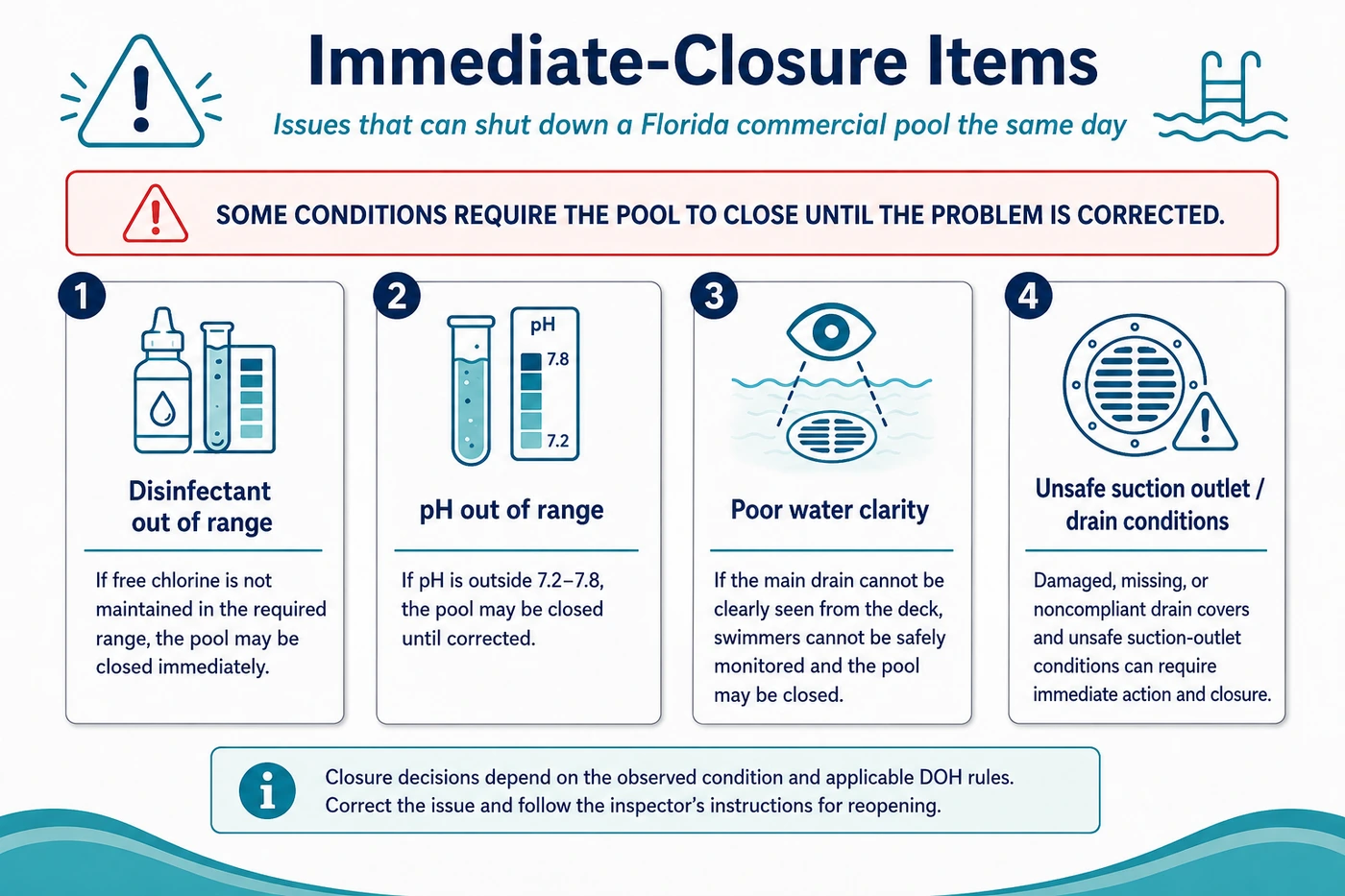
A DOH inspection is a line-by-line pass or fail against the items below. Two of them, disinfectant and pH, can close a pool the same day if they are out of range. Treat this as your pre-inspection checklist.
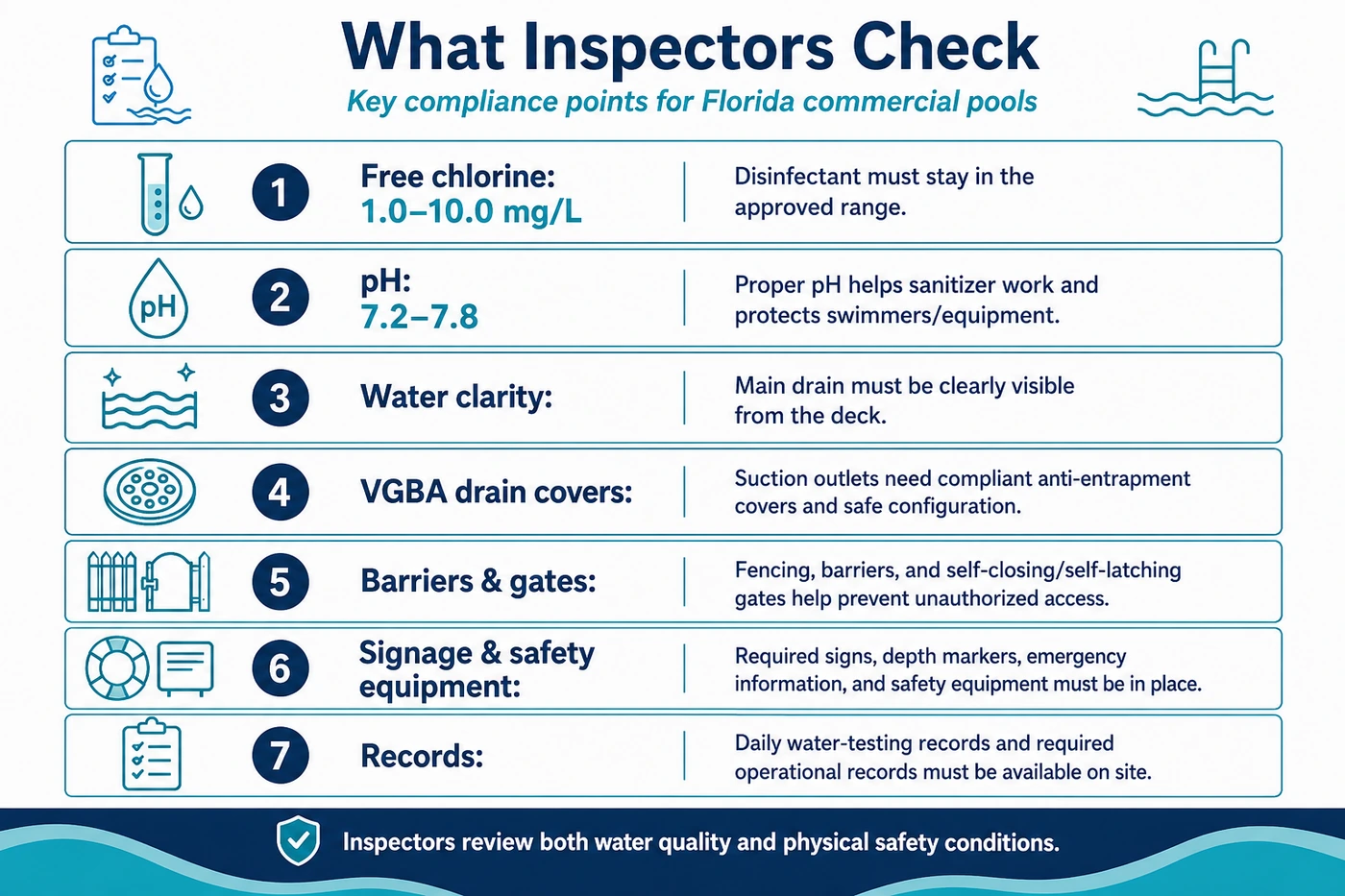
Disinfectant residual
Free chlorine 1.0–10.0 mg/L (bromine 1.5–6.0 mg/L)
Too low and the water is unsafe; a reading out of range can trigger an immediate closure on the spot. This is the number inspectors check first.
pH
7.2–7.8
Out-of-range pH makes chlorine ineffective, irritates swimmers and corrodes or scales equipment. Also an immediate-closure item if far out.
Water clarity
Turbidity 0.5 NTU or less; main drain clearly visible from the deck
The "can you see the main drain" test is the fast field check. Cloudy water hides a swimmer in distress and fails inspection.
Anti-entrapment drain covers
VGBA covers to ANSI/APSP/ICC-16, secured, within rated flow and service life
Federally required. Missing, cracked, unsecured or past-service-life covers are a serious violation. See the VGBA section below.
Recirculation & turnover
Pumps and filters sized to the required turnover rate
The system has to move and filter the whole pool volume on schedule, or the water cannot stay clear and sanitized.
Safety equipment & signage
Life ring and reaching pole, required rules, capacity, depth and emergency signage
Rescue equipment must be present and usable, and the required signs must be posted and legible.
Barriers & gates
Enclosure with self-closing, self-latching gates that open outward
The barrier is the primary drowning-prevention layer. A gate that does not self-close and latch is a common write-up.
Deck, depth markers & slip resistance
Non-slip surfaces, clear and correct depth markings
Faded depth markers and slick decks are frequent, easily-fixed findings that still cost you on the report.
Records & logs
Test pH and disinfectant at least every 24 hours; keep the monthly log 1 year on site
Even a perfect pool fails if the logs are not there. Inspectors ask for the records, and "we test but do not write it down" is not a pass.
Certified operator
A certified pool operator responsible for the water
The rule expects a trained, certified person accountable for maintaining the pool. Every one of our technicians is DOH state certified.
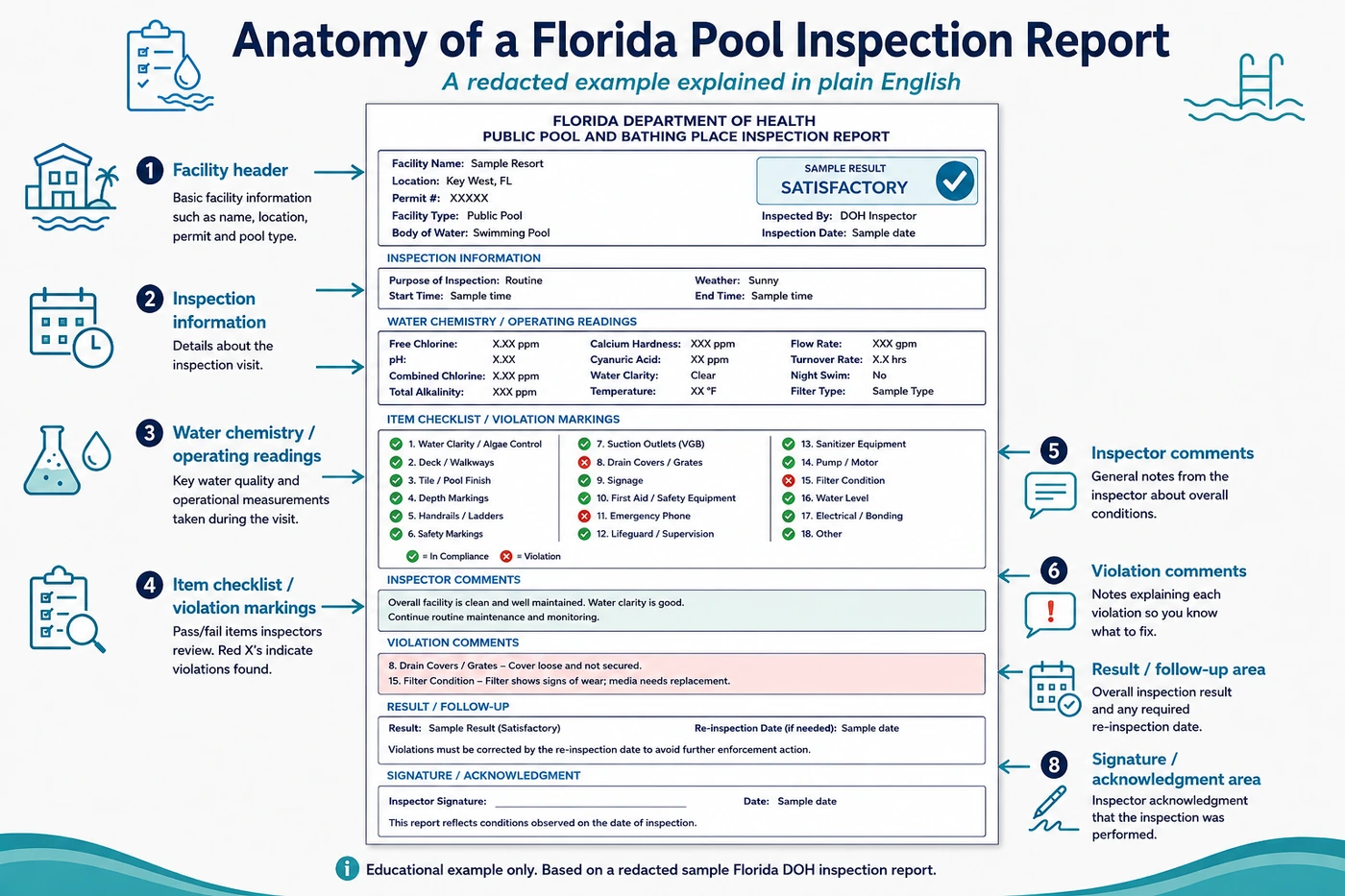
On the report itself, each item is marked satisfactory or as a violation, with a comment. Our clients get a walkthrough of any findings and the fix before the ink is dry.
The One Most Owners Get Wrong
VGBA main drains and anti-entrapment
The Virginia Graeme Baker Pool & Spa Safety Act is a federal law aimed at suction-entrapment drownings. It applies to every public pool and spa, and it is where we find the most expensive surprises during a change of ownership or a renovation.
Certified drain covers
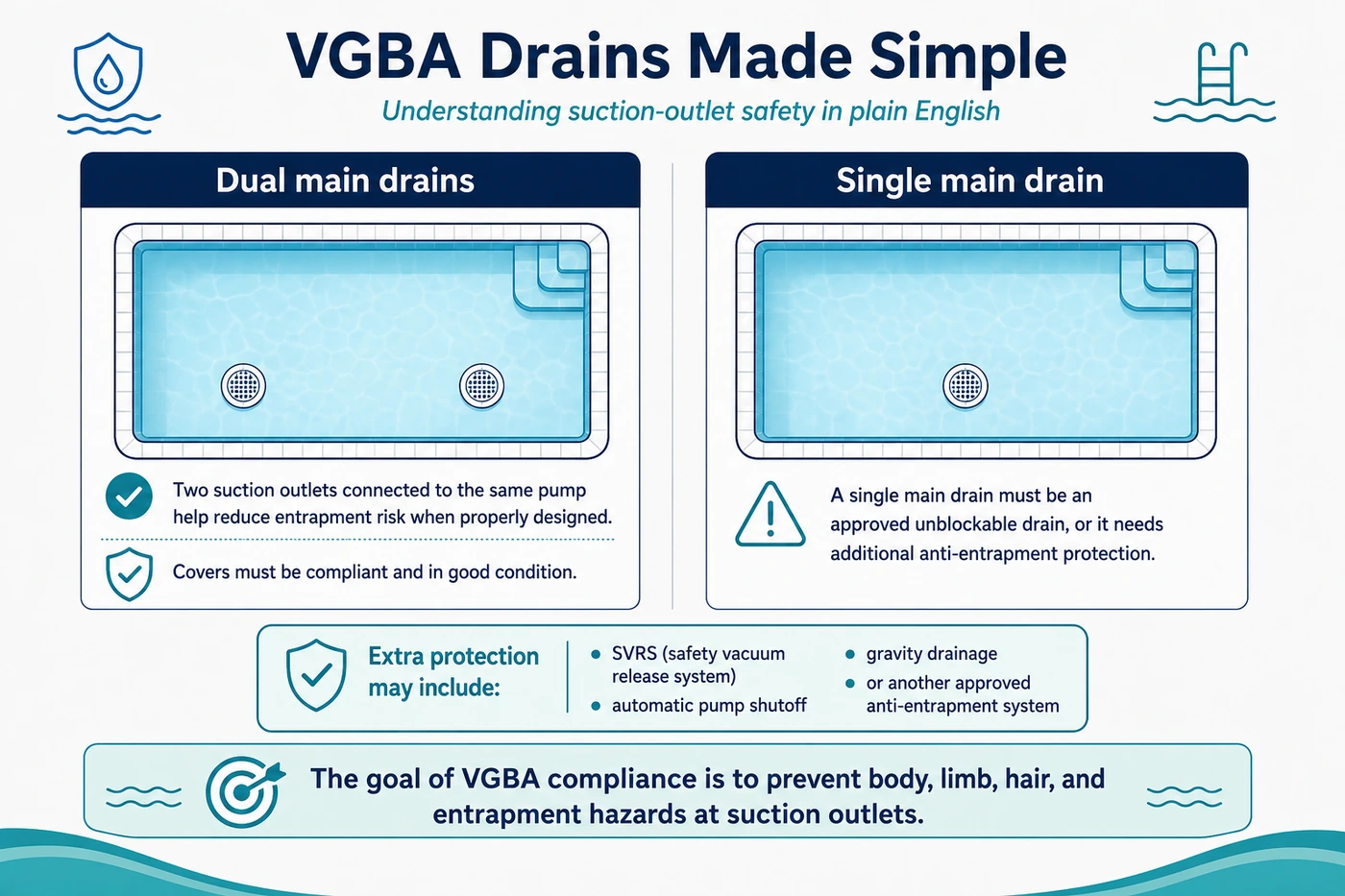
Every main drain needs a suction-outlet cover certified to the current ANSI/APSP/ICC-16 standard, properly secured and matched to the system's flow rate. Covers carry a manufacturer-marked service-life date, and one past that date is a violation even if it looks fine. (CPSC)
Single vs. dual drains
A single blockable main drain must have a second layer of protection: an SVRS (safety vacuum release system), automatic pump shut-off, gravity drainage or a suction-limiting vent. Dual main drains more than three feet apart may be exempt from the second system.
How it affects your pool
If you do not know whether your drains are compliant, assume nothing. We can inspect your main drains, confirm cover certification and dates, and lay out exactly what, if anything, is required, before an inspector or a buyer's due-diligence team does.
The records that keep you open
A perfectly clean pool still fails inspection if the paperwork is not there. The rule requires that you test pH and disinfectant at least every 24 hours and keep the results on the department's monthly report form (or an approved equivalent) for one year, on site. At minimum, your daily record should capture:
- Date and time of the reading
- Free (and total) chlorine or bromine
- pH
- Water clarity and temperature
- Any chemicals added and equipment notes
- Initials of the person who took the reading
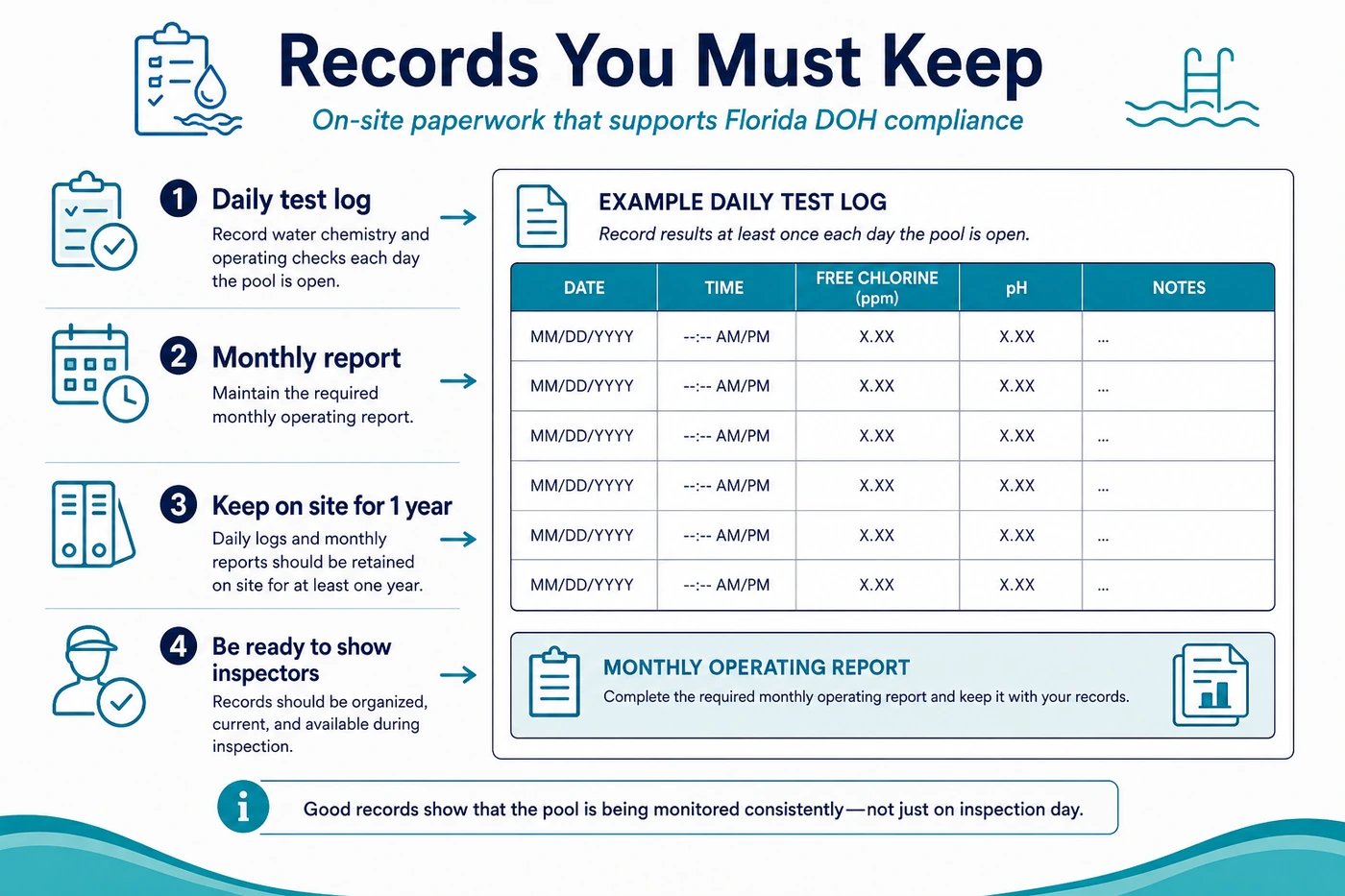
For our commercial clients, this is handled and documented as part of service, so the log is always current and always on the property when the inspector asks for it.
Keep These Bookmarked
Official forms & resources
Want our inspection-ready checklist and a daily-log template built for Keys properties? Ask and we will send them over.
Or hand the whole thing to a team that lives it.
We keep most of Key West's resort pools inspection-ready year-round: DOH-certified service, current logs, VGBA checks and same-island response when something needs to be fixed before an inspection.
This page is a plain-language summary to help Keys pool operators understand and prepare for Florida public-pool requirements, current as of July 2026. It is not legal advice and does not replace the official rule. Chapter 64E-9 F.A.C., Chapter 514 F.S., the Florida Building Code and the federal Virginia Graeme Baker Act govern. Always verify against the current rule and your Monroe County health department, since requirements change.